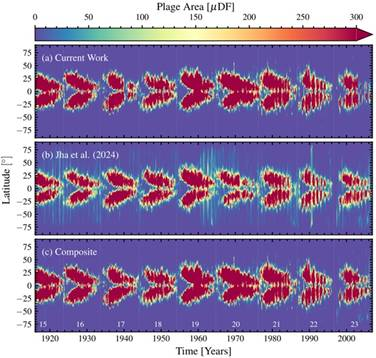
The study employed advanced AI-based image analysis to examine digitised observations spanning nearly 100 years, creating one of the most comprehensive records of solar surface activity. Plages, which appear brighter than their surroundings in specific wavelengths of light, serve as important indicators of the Sun’s magnetic field and solar cycles.
By automatically identifying and monitoring these bright regions across decades of observations, researchers have developed a more consistent and efficient method of studying long-term changes in solar activity. The AI-driven approach reduces manual effort while improving the accuracy and speed of analysing large historical datasets.
The century-long archive from the Kodaikanal Solar Observatory is among the world’s oldest continuous records of solar observations. Combining this invaluable dataset with modern AI techniques allows scientists to better understand the evolution of solar magnetic activity and improve models used to forecast space weather.
The findings are expected to contribute to research on solar cycles, enhance predictions of solar storms, and strengthen preparedness for space weather events that can affect satellites, communication systems, navigation networks, and power infrastructure on Earth.