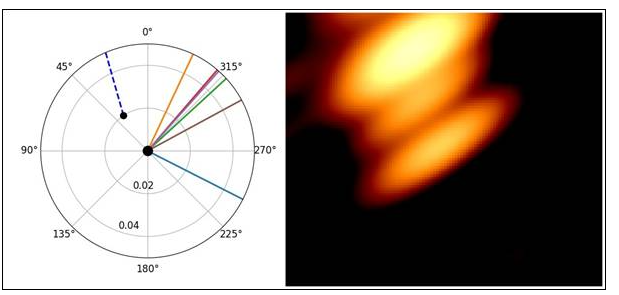
The discovery was made possible through a global network of radio telescopes working in tandem with the RadioAstron satellite, enabling scientists to detect distinct radio emissions and powerful jets emanating from both black holes. The alignment and morphology of these emissions provided clear visual evidence of their orbital motion.
“This is the first time we’ve been able to directly image two black holes orbiting each other,” researchers said, describing the find as “a monumental breakthrough” in understanding black hole evolution and galaxy mergers.The finding has profound implications for astrophysics. It provides visual confirmation of binary black hole systems, a phenomenon previously inferred only from gravitational wave detections. The study also helps scientists better understand how supermassive black holes grow through mergers — a key process shaping galaxies across the universe.
Experts say the discovery opens new frontiers in studying gravitational dynamics, space-time distortions, and the final stages of black hole collisions, which produce ripples detectable by gravitational wave observatories like LIGO and Virgo. This unprecedented image marks a new era in high-resolution cosmic observation, giving humanity a glimpse into one of the universe’s most extreme and fascinating interactions.